
Prime Minister Narendra Modi is in New Zealand during a visit which has become one of the biggest developments in India’s growing relations with the Indo-Pacific region. India-New Zealand relations have made historic steps, with the visit to Auckland placing trade, investment, defence and maritime security at the forefront of cooperation as well as long-term strategic partnership.
In particular the visit assumes significance because it is the first visit by Indian Prime Minister to New Zealand in four decades. Prime Minister Modi visited Auckland on July 10–11, 2026 after the trip to Indonesia and Australia.
During the visit, Prime Minister will also hold a bilateral meeting with his New Zealand counterpart Christopher Luxon. Both countries upgraded bilateral ties into a “strategic partnership”, signalling an even broader departure from traditional diplomatic engagement between states toward closer economic and security relations.
And bad timing also. In April 2026, India and New Zealand agreed to a Free Trade Agreement (FTA), resulting in robust economic underpinnings for bilateral relations. The leaders are now looking to translate this momentum into increased trade, investment, business collaboration and strategic coordination.
The New Zealand visit is also part of India’s larger Act East Policy and MAHASAGAR vision, as well as its commitment to a free and open Indo-Pacific. New Zealand on the other hand would gain access to one of the largest and fastest growing major economies in the world.
Why is PM Modi New Zealand visit important?
Reasons include its historical and strategic significance as Prime Minister Narendra Modi visits New Zealand.
The visit is the first by an Indian Prime Minister in around 40 years to New Zealand. It makes the diplomatic engagement highly symbolic.
But the nature of the visit is much more than such symbolism.
India, meanwhile, wants to build a new partnership with New Zealand based on an increasingly prosperous contemporary relationship involving trade and investment, regional stability, defence cooperation, education and technology links and strong people-to-people ties.
An Historic India New Zealand Relationship Moment
Bilateral ties between India and New Zealand have now spanned decades but the strategic and economic promise remained little more than that at best.
That situation is changing rapidly.
The reason why New Zealand has prioritised India as a strategic partner is on account of India’s economic size and global influence, in addition to its growing importance to the Indo-Pacific.
India-New Zealand two-way trade is around NZ$3.95 billion per year, according to New Zealand’s official trade data. For the year ended December 2025, India was also New Zealand’s 11th largest goods and services export market.
Political momentum provided by PM Modi’s visit for expansion of the relationship.
There: From bilateral to strategic partnership
Perhaps the most significant result of the Auckland engagement is to upgrade India-New Zealand relations into a strategic partnership.
A strategic partnership usually implies cooperation that goes beyond the limits of usual diplomatic and commercial relationships.
The focus increasingly includes:
- Trade and investment
- Defence cooperation
- Maritime security
- Education and talent mobility
- Innovation and technology
- Regional security
- People-to-people relations
- Indo-Pacific cooperation
India and New Zealand are seeing each other more as long-term partners, as this broader agenda demonstrates.
During the visit of PM Modi, it is anticipated that trade will take centre stage.
Trade is one of the most important pillars of Prime Minister Modi’s New Zealand visit.
Free Trade Agreement between India and New Zealand: on 27 April, 2026 THE HUGE OPPORTUNITY you NEED TO know You are trained up to October 18th, 2023
India-New Zealand Free Trade Agreement alters the economic partnership set up to date
India-New Zealand FTA, will be a landmark in economic linkages between both nations.
The free trade agreement is expected to provide zero-duty market access for Indian exports in New Zealand. The official evaluation of the Indian government notes possible gains for sectors with high labour content, MSMEs, women-owned businesses and start SMEs and exporters.
The pact is expected to remove or reduce 95% of tariffs on New Zealand’s exports to India when fully implemented. The New Zealand government estimates that 57% of the eligible New Zealand exports under the arrangement will be highly likely to be tariff-free on day one.
Such market-access measures might prompt companies in both countries to develop potential supply chains and commercial partnerships.
In Which Sectors, Indians Could Get Benefit?
Some Indian segments that can benefit from greater access to the New Zealand market include:
Should the trade barriers come down, textiles and garments, leather and footwear, engineering products paper and pharmaceuticals could be major beneficiaries in terms of growth from a trade perspective.
The Modi government may have decided that at least some new opportunities would spring up for Indian MSMEs, as the trade agreement produces a more organized commercial record.
The long term effect, so far as they are not concentrated on tariffs only, depends whether businesses grasp adequately the benefits of tariff, rules of origin and product standards & market requirements.
Investment cooperation high on the agenda
Investment has also obtained an important place in the India-New Zealand economic partnership.
Official Indian information on the FTA refers to a linked USD 20 billion investment commitment that will enhance long-term economic and strategic partnership.
Prime Minister Modi has stressed greater win-win cooperation in agriculture, manufacturing, innovation and technology.
Why New Zealand Investors Should Take a Closer Look at India
India has many compelling reasons that can help attract foreign investment.
Key enablers range from a large consumer market to evolving digital infrastructure, increased startup ecosystem and rising demand across manufacturing and services.
However, India’s economic aspirations also result in the emergence of investment opportunities in infrastructure projects, technology development, clean energy and advanced manufacturing.
In contrast, many businesses in New Zealand include technology (AgTech), food innovation and specialised services.
It opens up the possibility for synergistic economic collaboration.
Opportunities for Indian Companies in New Zealand
The association goes beyond New Zealand capital being invested in India.
Indian companies could also identify New Zealand as a market for goods, services, technology and international business opportunities!
The FTA may motivate Indian exporters to work in greater details on market research and also local commercial tie-ups.
The prospect should be strongest for Indian businesses where they can bring competitively priced products together with quality, compliance and dependable supply chains.
Expanded Defence a Maritime Security Cooperation
There is also a strategic dimension to PM Modi’s New Zealand visit.
India-New Zealand defence and maritime security cooperation has been in the works as part of their larger strategic partnership.
This is especially pertinent given both countries share interests in a peaceful, stable and rules based Indo-Pacific.
The Indo-Pacific Factor
The increased importance of the Indo-Pacific also stems from the geopolitical realities at play in global diplomacy.
The area is crossed by major international trade routes, and governments have prioritized maritime security, supply-chain resilience and regional stability.
The point here, therefore, is that New Zealand must not be viewed as a counter to India’s engagement with the West but rather within the broader Indo-Pacific geography.
Such was the justification for Prime Minister Modi’s planned, but ultimately delayed, 2026 diplomatic tour of Indonesia, Australia and New Zealand that complements a growing Indian strategic interest in partnerships throughout the eastern to southern Indian Ocean and broader Pacific.
Maritime Security and Regional Stability
Indian maritime cooperation has become a notable aspect of its foreign policy.
As a Pacific nation, New Zealand also has a strong interest in ensuring maritime safety and regional security.
Closer defence dialogue and maritime cooperation could facilitate better coordination on shared security concerns.
The strategic partnership does not imply that India and New Zealand will line up on every international problem. It gives instead a more robust foundation for conversation and tangible collaboration.
Focus on education and skills and talent mobility
Education and professional mobility are turning into key planks of India-New Zealand relations.
ASEAN formation — India has a very young population and skilled professionals are growing at an astonishing rate 3. Education in New Zealand is world class and pick professions have a need for specialists — Source: myeligibilities.
The framework of the India-New Zealand FTA relates to student mobility and professional opportunities.
Opportunities for Indian Students
Indian official information about the agreement mentions post-study rights of up to three years for STEM bachelor and master graduates, and four years for PhD holders.
While education and talent might increasingly matter, these provisions risk making it a larger part of bilateral relations.
Nevertheless, students must always confirm their eligibility based only on current visa conditions and programme rules from government sources before making any education or immigration decisions.
Experts in professional fields and the pattern of their turnover
According to official Indian information, the deal also provides for a temporary employment entry stream with 5000 quota for identified skilled occupations.
This could open up new avenues for Indian professionals who qualify.
Mobility should also be seen as a process governed by rules of visa, professional qualifications and employment requirements at the same time.
In broader terms, this means talent is being integrated into the economic diplomacy between India and New Zealand.
The Indian Diaspora as a Living Bridge Between Both Academies
Indian community in New Zealand is an important pillar of bilateral relations.
The official trade information of New Zealand refers to its Indian diaspora — numbering over 300,000 members — as a “living bridge” for cultural, commercial, educational and social linkages.
Part of Prime Minister Modi’s programme in Auckland includes interactions with the Indian community.
Why People-to-People Ties Matter
Even though government agreements could establish policy parameters on paper, it is often people — namely citizens and entrepreneurs— who cement long-term bilateral partnerships.
It is Students and professionals, entrepreneurs, business owners and families who make direct link between country.
The Indian diaspora can play a big role supporting business networking, cultural understanding and educational cooperation.
Such a stepping stone is especially important because India-New Zealand relations are rapidly moving beyond just government-level exchanges.
Significance of PM Modi’s New Zealand Visit for India
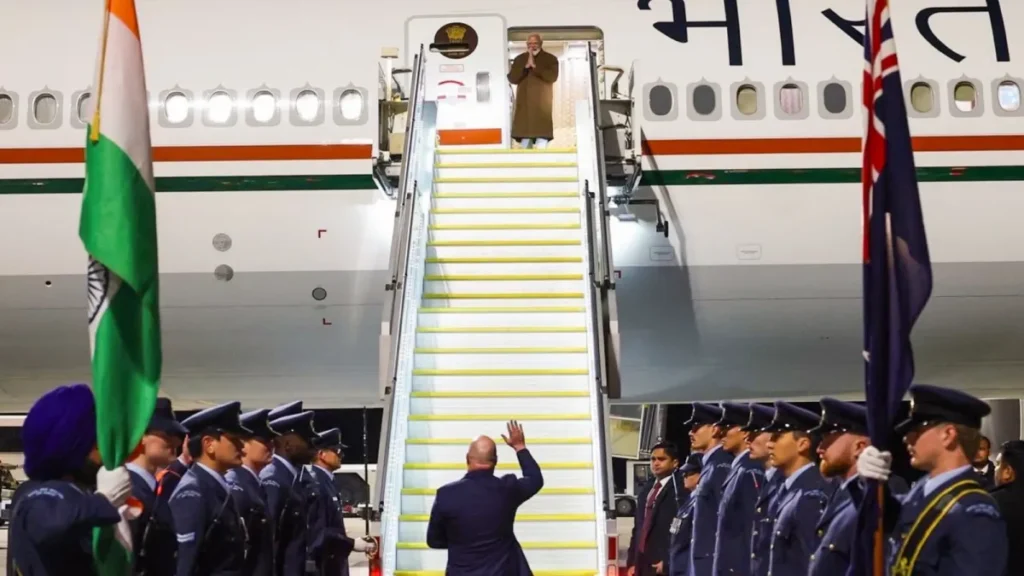
The New Zealand visit serves multiple foreign-policy and economic priorities for India.
To begin with, it boosts access to India’s diplomacy in the Indo-Pacific.
Secondly, it bolsters the FTA-based market access for Indian exporters.
Third, it offers possible chances for joint ventures and scientific and agricultural collaborations.
Fourth, the linkage is related to education and career mobility.
Closer relations with New Zealand also play into India’s broader approach of pursuing diverse global partnerships.
A Correction And An Opportunity For India’s Act East Policy
The visits by Prime Minister Modi to Indonesia, Australia and New Zealand are interlinked with Indian’s Act East Policy and broader Indo-Pacific vision as well.
Thus, India’s relationship with New Zealand is but a cog in the larger diplomatic wheel.
It seeks to bolster economic and strategic partnership with countries that will matter most for sustainable economic growth and stability in the region.
What is the Importance of The Visit for New Zealand
India is a huge economic and strategic opportunity for New Zealand.
An important long term partner, given the sheer size and questions surrounding article symbols, creating economic middle classes/ global influence of India.
New Zealand exporters may be able to diversify their international markets through the FTA.
An enhanced political relationship with India will also bolster New Zealand’s presence in the Indo-pacific.
Prime Minister Christopher Luxon’s government has emphasised how significant India is to New Zealand’s prosperity.
As such, the relationship becomes ever more rooted in commonsensical economic and geostrategic necessity.
Major Hurdles in Bilateral Ties between India and New Zealand
Even with the momentum, there were challenges to come.
Trade agreements require effective implementation. Market-access restrictions need to be understood by businesses, while legislative barriers await action by governments.
Bilateral relations can also be shaped by political debates on trade, immigration and foreign policy.
Thus, India and New Zealand may not always have overlapping strategic outlooks.
This is why the success of the new strategic partnership will depend on continuous dialogue, institutional cooperation and concrete action.
The Real Challenge Will Be Implementation
While diplomatic announcements can generate momentum, in the long term it is really about results.
The key questions will include:
Will bilateral trade grow significantly?
Do you expect FTA to open some tangible opportunities for the exporters and MSMEs?
But will the investments to commitments materialise into projects?
Does this mean a more institutionalised defence and maritime cooperation?
Does it work for mobility of students and skilled professionals?
These answers will shape the long-term effect of PM Modi’s New Zealand visit.
The Future of India-New Zealand Relations
India-New Zealand relations, it is thus safe to expect, will be more and more defined by economics, security and people-to-people cooperation.
In turn, a new economic framework built upon the 2026 Free Trade Agreement has crushed many trade barriers.
Upgrading the bilateral relationship to a strategic partnership introduces a broader geopolitical context.
This metamorphosis has received high-level political impetus with Prime Minister Modi’s historic Auckland visit.
The succeeding stage will no doubt center around actualizing exchange responsibilities, supporting speculation, growing safeguard participation and fortifying official connections.
New Zealand Visit of PM Modi is a Step Towards an Opening
This is Prime Minister Narendra Modi’s New Zealand visit, in terms of India-New Zealand relations.
The trip is historic as it marks the first visit by Indian Prime Minister to New Zealand since 40 years. Above all, it signals a departure from the shallow and informal partnership.
The relationship continues to revolve around trade and investment, particularly with the signing of the India-New Zealand Free Trade Agreement in April 2026.
Simultaneously, defence cooperation, maritime security, education and talent mobility as well as Indo-Pacific engagement are broadening the horizon of bilateral ties.
In the broader Indo-Pacific context, New Zealand is becoming a more relevant economic and strategic partner for India. Both for New Zealand, India’s economic growth and global role provide very considerable long-term opportunities.
The first place where the consequences of PM Modi’s New Zealand visit will be felt is in implementation. If trade commitments, investment plans and strategic cooperation yield concrete results, 2026 could mark a watershed in India-New Zealand ties.
Frequently Asked Questions on PM Modi New Zealand Visit
The reason why Prime Minister Narendra Modi visited New Zealand
New Zealand: Prime Minister Narendra Modi visit to New Zealand focused on strengthening bilateral ties in the contexts of trade, investment, defence and strategic cooperation and people-to-people contacts.
PM Modi visited New Zealand in which year?
PM Modi Went on a State Visit to Auckland, New Zealand (July 10–11, 2026)
Why is PM Modi’s New Zealand visit historic?
This will be the first state visit by an Indian prime minister to New Zealand in almost 40 years.
What is India-New Zealand Free Trade Agreement?
A comprehensive Free Trade Agreement between the India and New Zealand, signed on 27 April 2026 to reduce or eliminate such procedures, enhance market forces, and improve access into national markets with each other (please refer List of bilateral free trade agreements)
Where might India-New Zealand cooperation wields the greatest salt?
Bilateral cooperation could go deep in trade, manufacturing and textiles, agriculture, technology, education, pharmaceuticals, professional services and innovation.
The New Zealand Visit and Indo-Pacific Strategy of India
The visit furthers India’s strategy for greater engagement with Pacific partners and supports its Act East Policy, MAHASAGAR vision and broader Indo-Pacific approach for a free and open region.